

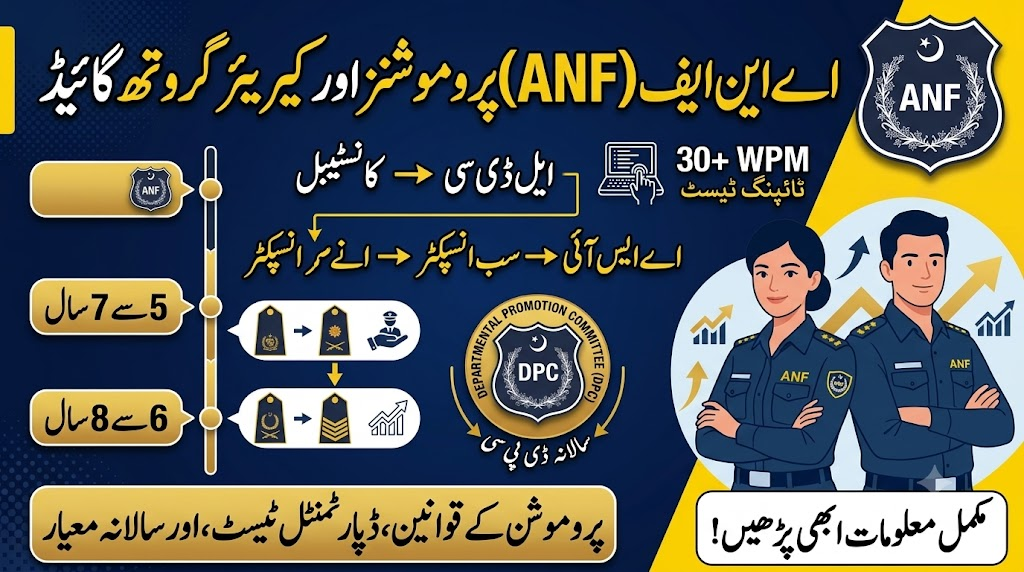
The Anti Narcotics Force (ANF) provides a well-defined career growth hierarchy for its uniformed and administrative personnel. Candidates applying for entry-level positions often wonder about the future scope, promotion channels, departmental exams, and required service years to reach higher ranks.
Whether you enter as a Constable (BPS-07), Lower Division Clerk (LDC BPS-11), Assistant Sub-Inspector (BPS-11), or Sub-Inspector (BPS-14), understanding the Departmental Promotion Committee (DPC) policies, typing criteria, and seniority-based promotions is essential for long-term career planning.
Overview of ANF Promotion Mechanisms
Promotions in the Anti Narcotics Force are primarily governed by two main channels:
- Departmental Examinations & Skill Qualification: Switching streams (e.g., from Executive field staff to Ministerial/Clerk cadre).
- Seniority-cum-Fitness Basis (DPC): Progression to higher operational ranks evaluated by the Departmental Promotion Committee (DPC), which convenes every year to review eligible candidates.
1. Constable (BPS-07) Promotion & Career Paths
For entry-level Constables, ANF offers two distinct promotion trajectories depending on whether you want to remain in field operations or transition into ministerial roles.
Option A: Constable to LDC (Ministerial Switch)
Constables who wish to move into desk-based, administrative jobs can apply for conversion/promotion to Lower Division Clerk (LDC – BPS-11) through internal departmental procedures.
- Eligibility Criteria: Satisfactory initial service tenure and clearing the internal departmental skill test.
- Typing Speed Requirement: Candidates must achieve a typing speed of 30+ words per minute (WPM) on a computer.
- Advantage: Opens up an administrative hierarchy leading to UDC (BPS-13), Assistant (BPS-15), and Superintendent posts.
Option B: Executive Promotion (Constable → Head Constable → ASI)
If a Constable chooses to stay in active law enforcement:
- Promotion from Constable (BPS-07) to Head Constable (BPS-09) and subsequently ASI (BPS-11) is processed through DPC based on service record, fitness, clean ACRs (Annual Confidential Reports), and passing mandatory promotional courses.
2. ASI to Sub-Inspector Promotion (Seniority-Based)
Promotions from Assistant Sub-Inspector (ASI – BPS-11) to Sub-Inspector (SI – BPS-14) are strictly managed on a Seniority-cum-Fitness basis through annual DPC meetings.
- Required Service Experience: Typically 5 to 7 years of continuous active service as an ASI.
- Mandatory Requirements:
- Clean service record with no major penalties or disciplinary actions.
- Successful completion of the mandatory Intermediate Promotional Course conducted at the ANF Academy/Police Training Schools.
- Favorable Annual Confidential Reports (ACRs) evaluated by the Departmental Promotion Committee.
Aslo Read More About: ANF interview preparation guide
3. Sub-Inspector to Inspector Promotion
The transition from Sub-Inspector (SI – BPS-14) to Inspector (BPS-16) represents a major career milestone, shifting an officer into Gazetted-level command responsibilities.
- Required Service Experience: Approximately 6 to 8 years of regular service as a Sub-Inspector.
- Promotion Channel: Purely Seniority-Based (DPC).
- Key Factors for Selection:
- Seniority position in the provincial/national merit list maintained by ANF HQ.
- Successful completion of the Upper Course.
- Demonstrated leadership during anti-smuggling raids, investigations, and court trial proceedings.
Complete ANF Rank Hierarchy & Timeline Summary
| Current Rank | Target Rank | Promotion Mode | Service Required / Criteria |
| Constable (BPS-07) | LDC (BPS-11) | Departmental Test | 30+ WPM Typing Speed + Service Fitness |
| Constable (BPS-07) | Head Constable / ASI | DPC / Seniority | 5–7 Years + Basic Promotional Course |
| ASI (BPS-11) | Sub-Inspector (BPS-14) | Seniority (DPC) | 5 to 7 Years + Inter-Course + Clean ACRs |
| Sub-Inspector (BPS-14) | Inspector (BPS-16) | Seniority (DPC) | 6 to 8 Years + Upper Course |
| Inspector (BPS-16) | Assistant Director (BPS-17) | DPC / FPSC Direct | DPC Selection or FPSC Open Competition |
Role of the Departmental Promotion Committee (DPC)
The Departmental Promotion Committee (DPC) in ANF meets every year to evaluate the promotion files of eligible personnel across all cadres.
How DPC Evaluates Candidates:
- Seniority List Placement: Verification of the official merit date.
- ACR Evaluation: Scoring the past 5 years of performance evaluations submitted by reporting officers.
- Disciplinary Status: Ensuring there are no pending departmental inquiries, NAB cases, or court proceedings.
- Course Completion: Verifying that the candidate has completed all required promotional training courses.
Key Takeaways for Aspirants & Employees
- Annual DPC Cycles: Unlike some departments where DPC gets delayed for years, ANF maintains regular annual DPC evaluations for steady progression.
- Clerk Cadre Shortcut: Constables with good computer typing skills (30+ WPM) can fast-track their transition into administrative scales via LDC roles.
- Importance of Service Record: Since promotions from ASI onward are seniority-based, keeping a penalty-free record is crucial for timely promotion within the 5–7 year (ASI → SI) and 6–8 year (SI → Inspector) windows.
Conclusion & Final Thoughts
In conclusion, the Anti Narcotics Force (ANF) offers a highly structured, transparent, and rewarding career progression path for dedicated personnel. Whether you start your journey as an operational officer in the field or transition into administrative roles through departmental typing tests, steady promotions are guaranteed through regular annual DPC cycles. By maintaining an exemplary service record, completing required promotional training courses, and demonstrating professional discipline, officers can successfully rise through the ranks from entry-level positions to gazetted officer ranks over time.
