

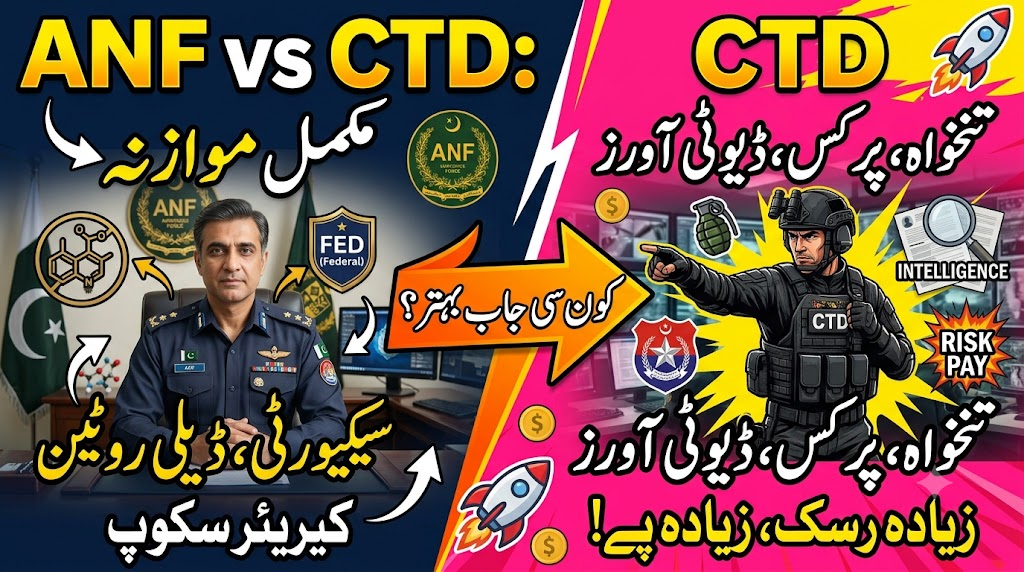
Choosing between the Anti Narcotics Force (ANF) and the Counter Terrorism Department (CTD) is a major decision for candidates aspiring to join Pakistan’s law enforcement and law enforcement intelligence frameworks. While both organizations operate at the frontline of national security, their jurisdiction, risk structure, salary allowances, operational routines, and career progression paths differ significantly.
This comparative guide breaks down the core distinctions between ANF and CTD to help you evaluate which career path suits your goals.
1. Organizational Setup & Jurisdiction
| Feature | Anti Narcotics Force (ANF) | Counter Terrorism Department (CTD) |
| Parent Body | Ministry of Narcotics Control (Federal) | Provincial Police Departments (e.g., Punjab/KP/Sindh Police) |
| Primary Mandate | Interdiction of illicit drug trafficking, narcotics money laundering, & supply reduction | Counter-terrorism operations, intelligence gathering, & anti-extremism investigations |
| Jurisdiction | Federal (Pan-Pakistan, including borders, ports, & international airports) | Provincial (Operates within respective provincial boundaries) |
| Military Alignment | Deputation leadership (Director General is typically a serving Major General) | Led by senior Police Service of Pakistan (PSP) officers (e.g., Additional IG / DIG) |
2. Salary Structure & Risk Allowances Comparison
Both departments offer specialized allowances above the standard Basic Pay Scales (BPS) due to operational hazards, but CTD generally holds an edge in monthly risk compensation depending on provincial sanctions.
ANF Financial Package
- Base Pay: Standard Federal Basic Pay Scales (BPS-07 Constable to BPS-17+ Officers).
- Special Risk Allowance: Entitled to Anti-Narcotics Special Allowance (typically up to 20%–100% of basic pay based on post and posting profile).
- Hardship Allowance: Granted for field postings along remote border checkpoints (e.g., Balochistan and KPK entry corridors).
- Average Starting Salary (Constable BPS-07): PKR 55,000 – 65,000+
CTD Financial Package
- Base Pay: Standard Provincial Police Pay Scales.
- Counter Terrorism (CT) Allowance: CTD personnel receive a dedicated Counter-Terrorism Allowance (often equal to 100% running or initial basic pay depending on the province).
- Special Risk Pay: High operational risk bonuses for frontline Corporals, Intelligence Officers, and Strike Teams.
- Average Starting Salary (Constable / Corporal BPS-07 / BPS-09): PKR 55,000 – 70,000+ (Varies by province)
Takeaway: CTD generally pays higher monthly operational risk allowances due to active anti-terror mandates, while ANF provides uniform federal benefits and national-level posting allowances.
3. Duty Hours & Work-Life Balance
ANF (Anti Narcotics Force)
- Operational Shift: Standard 8 to 12-hour shifts at fixed postings (Airport Checkpoints, Seaports, Regional Headquarters).
- Field Raids & Surveillance: Intelligence gathering and anti-smuggling raids require unpredictable hours, but non-field administrative and airport security teams follow scheduled shifts.
- Relocation: Postings rotate across all provinces, requiring personnel to serve away from their home stations periodically.
CTD (Counter Terrorism Department)
- High-Intensity Routine: CTD intelligence operators and response teams remain on 24/7 call readiness.
- Targeted Operations: Involves high-stress counter-intelligence, raid execution, and counter-insurgency tracking.
- Local Postings: Postings remain strictly within your home province, allowing better proximity to family compared to federal rotations.
4. Perks, Benefits & Facilities
Both agencies offer strong institutional support, but their medical and housing networks reflect their federal vs. provincial nature:
- Medical Facilities:
- ANF: Medical cover with access to panel hospitals, Federal Government Services, and Combined Military Hospitals (CMH) for authorized treatments.
- CTD: Coverage under the Provincial Police welfare framework and designated government/teaching hospitals.
- Housing & Quarters:
- ANF: Federal Government Housing Quotas and ANF official barracks at regional hubs.
- CTD: Police Lines accommodation, official quarters, and provincial police welfare plots/schemes.
- Shaheed Package:
- Both organizations maintain comprehensive Martyr/Shaheed Assistance Packages, offering full salary continuity, lump-sum financial support, official plot allocations, and job quotas for dependents in case of line-of-duty casualties.
Also Read More About: ANF Training Academy Life Training Modules & Academy Locations
5. Career Scope & Promotion Opportunities
ANF Promotion Ladder:   Constable (BPS-07) ➔ ASI (BPS-11) ➔ Sub-Inspector (BPS-14) ➔ Inspector (BPS-16) ➔ Assistant Director (BPS-17)
CTD Promotion Ladder:   Corporal/Constable ➔ Head Constable ➔ ASI ➔ Sub-Inspector ➔ Inspector ➔ DSP/SSP (PSP Cadre)
ANF Career Growth
- Scope: Opportunities for international liaison deployments with foreign drug enforcement partners (UNODC, DEA), airport security management, and national border enforcement.
- Promotion Cadre: Direct departmental promotions move through structured seniority boards, though top executive seats (Director / DG) are often filled by military deputation officers.
CTD Career Growth
- Scope: Advanced training opportunities in counter-intelligence, digital forensics, explosives handling, and tactical assault.
- Promotion Cadre: Fast-track promotion incentives exist for exceptional performance in anti-terror operations, within the broader provincial police hierarchy.
Which One Should You Choose?
- Choose ANF if you want: A federal government post, national/international operational scope, structured airport and border deployments, and uniform country-wide posting options.
- Choose CTD if you want: Higher monthly risk allowances, tactical/intelligence specialization in counter-terrorism, and the ability to stay posted within your native province throughout your career.
