

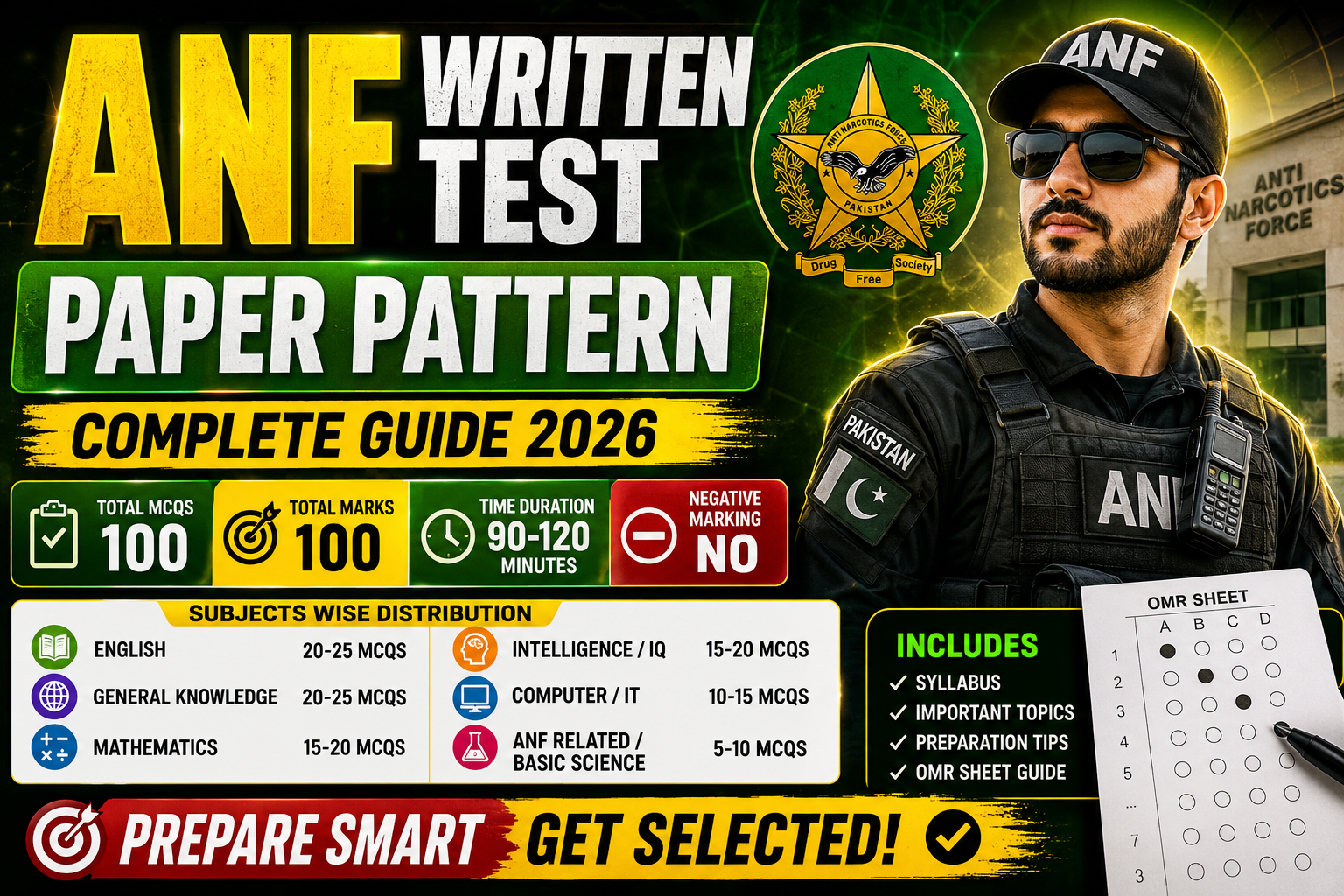
If you are planning to apply for the Anti Narcotics Force (ANF) jobs, understanding the ANF written test paper pattern is the first and most important step. Every year, thousands of candidates apply, but only those who prepare smartly according to the paper pattern succeed. This guide will help you clearly understand the test structure, subjects, and preparation strategy.
Overview of ANF Written Test Pattern
The ANF written test is designed to evaluate a candidate’s basic knowledge, analytical skills, and problem-solving ability. The test is usually objective-based (MCQs).
Key Highlights:
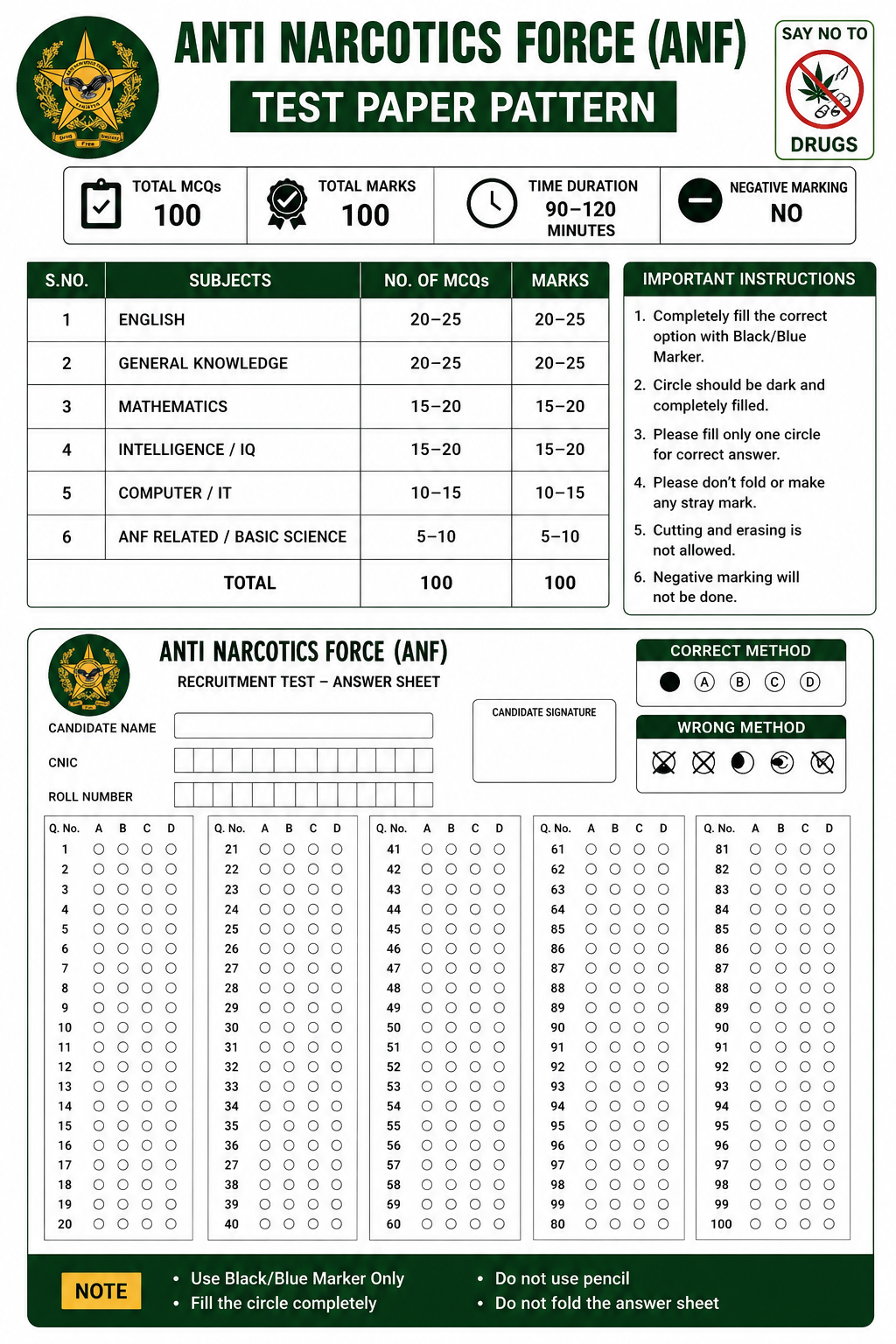
- Total Questions: 100 MCQs
- Total Marks: 100
- Time Duration: 90 to 120 minutes
- Negative Marking: No (in most cases)
- Paper Type: Multiple Choice Questions (OMR Sheet)
Candidates are required to fill circles on an OMR sheet, similar to other government job tests in Pakistan.
Subject-Wise ANF Test Distribution
The ANF paper is divided into multiple sections to test different skills. Below is the expected subject-wise breakdown:
1. English (20–25 MCQs)
The English portion checks your grammar and language skills. It includes:
- Synonyms and Antonyms
- Sentence Correction
- Prepositions
- Active & Passive Voice
- Reading Comprehension
👉 Tip: Focus on basic grammar rules and daily vocabulary practice.
2. General Knowledge (20–25 MCQs)
This section covers a wide range of topics:
- Pakistan Studies
- Current Affairs
- Islamiat
- International Events
👉 Tip: Stay updated with current news and revise Pakistan history.
3. Mathematics (15–20 MCQs)
The math section is usually basic but requires speed and accuracy:
- Percentages
- Ratios and Proportions
- Time & Work
- Basic Arithmetic
- Simplification
👉 Tip: Practice short tricks to solve questions quickly.
4. Intelligence / IQ (15–20 MCQs)
This part tests your logical thinking:
- Number Series
- Alphabet Series
- Coding-Decoding
- Odd One Out
- Analogy
👉 Tip: Solve past papers to understand patterns.
5. Computer / IT (10–15 MCQs)
Basic computer knowledge is essential:
- MS Word / Excel basics
- Internet and Email
- Hardware & Software
👉 Tip: Revise basic computer concepts from beginner-level notes.
6. ANF Related / Basic Science (5–10 MCQs)
This section is specific to the department:
- Drug-related information
- ANF Act roles and responsibilities
- Basic science questions
👉 Tip: Learn about anti-narcotics laws and drug awareness.
OMR Sheet Filling Instructions
The ANF test is conducted on an OMR sheet, so proper filling is very important.
Important Rules:
- Use Black or Blue Marker only
- Fill the circle completely
- Select only one option (A, B, C, D)
- Avoid cutting or overwriting
- Do not fold the answer sheet
Mistakes in OMR filling can lead to rejection, even if your answers are correct.
Preparation Tips for ANF Written Test
Preparing according to the ANF written test syllabus and pattern can significantly increase your chances of success.
Smart Preparation Strategy:
- Start with past papers to understand question trends
- Practice 100 MCQs daily
- Focus on weak areas first
- Manage time during practice tests
- Revise regularly
Consistency is the key. Even 2–3 hours of daily focused study can make a big difference.
- Also Read About: ANF Constable Test Preparation 2026 Past Papers
- Also Read About: ANF ASI Test Preparation 2026 Written Test
- Also Read About: ANF Sub Inspector Syllabus 2026 Test Preparation Guide
Final Words
The ANF written test paper pattern is not difficult if you prepare in a smart and structured way. The exam mainly focuses on basic concepts, so clarity is more important than cramming. By understanding the paper format, practicing regularly, and following the right strategy, you can easily secure good marks.
If you are serious about join ANF, start your preparation today and stay consistent. Success will follow
